




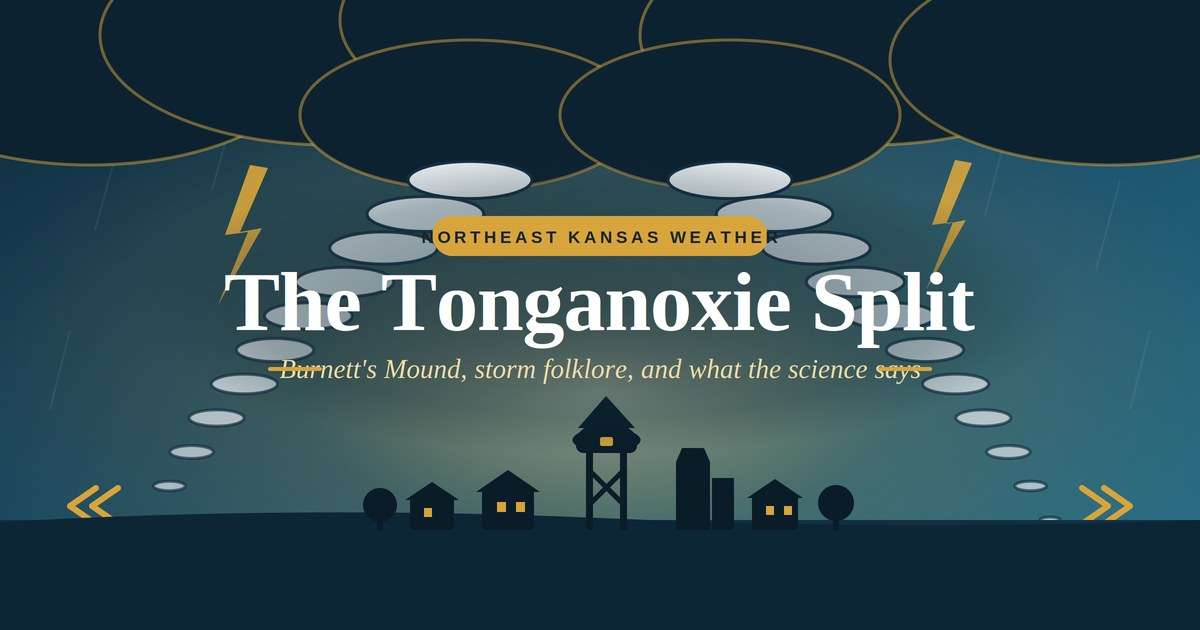
Before we debunk the legend, we salute it. Crack a lager, cue the accordion, and sing along while the radar does whatever it wants.
Not too far from Lawrence,
Sits a little town so fine,
When the sky turns green and angry,
And the sirens start to whine —
Well, the radar says we’re done for,
And the weatherman turns pale,
But we pour another lager,
‘Cause we’ve never known it to fail!
It’s the Tonganoxie Split! (Hey!)
One goes north and one goes south,
It’s the Tonganoxie Split! (Hey!)
Watch that storm cloud shut its mouth!
Let the thunder roll toward Tongie,
Let the twister do its dance —
It’ll tip its hat and part ways,
It don’t ever stand a chance!
Long ago a chief spoke plainly,
Said “There’ll be no storms no more,”
Some folks say he meant the fighting,
But the clouds heard something more —
Now they mind their manners kindly,
When they see our water tower,
They divide like Sunday brothers,
And they lose their huff and power!
It’s the Tonganoxie Split! (Hey!)
One goes north and one goes south,
It’s the Tonganoxie Split! (Hey!)
Watch that storm cloud shut its mouth!
Now the scientists come calling,
With their charts and their degrees,
Saying “Folks, it’s just the buildings,
Or the hills, or heat, or breeze” —
Well, professor, grab a bratwurst,
Pull a chair up, stay a while,
When that supercell splits open,
You’ll be singing with a smile!
(Accordion goes to town)
Oh, Topeka had a mound once,
And they didn’t treat it right…
So we honor what protects us,
Every stormy Kansas night!
It’s the Tonganoxie Split! (Hey!)
One goes north and one goes south,
It’s the Tonganoxie Split! (Hey!)
Watch that storm cloud shut its mouth!
Let it howl across the hills,
Let it grumble, let it spit —
There’s no cloud in all creation,
Beats the Tonganoxie Split! (HEY!)
Every region has its weather folklore. In Northeast Kansas, we have two of the best: a hill in Topeka that was supposed to stand guard against tornadoes, and an invisible line near Tonganoxie where storms supposedly split apart and spare the Kansas City metro.
One legend died spectacularly on a June night in 1966. The other is still repeated during severe weather season. It even has its own polka now.
Both stories tell us more about how people think than about how tornadoes behave. Let’s dig into each, and then into what meteorologists actually know.
The Legend of Burnett’s Mound
Burnett’s Mound sits on Topeka’s southwest edge, the highest point in the city. It’s named for Chief Abram Burnett, a Potawatomi leader who settled near the hill in the 1840s and owned the surrounding land.
Burnett was a skilled interpreter and negotiator who represented Potawatomi interests in treaty dealings. He is buried near the mound, which remains a site of significance to the Potawatomi people.
Somewhere along the way, Topekans began repeating a story: as long as the mound stood watch at the city’s southwest corner, no tornado could strike Topeka.
Because Plains storms often approach from the southwest, the mound seemed to stand directly between the city and danger.
The claim was often attributed to Native American tradition, though that attribution is murky at best and was likely embellished by later settlers. For decades, Topeka went largely unscathed, and the legend hardened into local identity.
June 8, 1966: The Night the Legend Died
Then came the evening of June 8, 1966. An F5 tornado, at the time one of the costliest in American history, came out of the southwest, passed directly over Burnett’s Mound, and carved a diagonal path of destruction through the heart of Topeka.
The damage path ran through the city and near the state capitol area. The tornado didn’t just ignore the mound; it practically used it as an on-ramp.
“For God’s sake, take cover.”
The warning became one of the most famous moments in broadcast weather history and is credited with saving lives.
Afterward, some locals didn’t abandon the legend. They revised it. The city had cut into the mound to build a water tank and roads, and a new version of the folklore held that disturbing the mound had broken its protection.
That’s the thing about protective legends: they rarely die from contrary evidence. They adapt.
The Tonganoxie Split. The Legend That Refuses to Die?
The Tonganoxie Split is a popular urban legend in Northeast Kansas that remains very much alive. The story suggests that severe storms split apart or weaken as they approach Tonganoxie and, by extension, that tornadoes avoid the town and spare communities to its east.
The term has been used for decades. A 1984 newspaper article mentioned weatherman Dan Henry using the phrase, and the legend became popular among local meteorologists in the 1980s as a tongue-in-cheek shorthand.
By 1994, meteorologists were publicly addressing the “Tonganoxie Split” as a myth in need of debunking. It didn’t matter. The phrase is still mentioned in local media during severe weather events, usually with a knowing wink, and sometimes without one. Now it even has a polka.
A tornado struck Tonganoxie in May 2000, directly contradicting the idea that the town is protected from tornadoes.
Just as with Burnett’s Mound, a direct hit didn’t kill the story.
What the Science Actually Says
The Tonganoxie Split borrows its plausibility from real meteorology and then misapplies it.
The Real Danger of a Comforting Story
These legends are charming right up until they’re not. A resident who half-believes the mound or the Split protects them may hesitate when the sirens sound.
The 1966 Topeka tornado is the permanent counterexample: the legend was strongest in the exact place the F5 struck.
No hill, town line, river, campus, skyline, polka, or local legend will protect you from a tornado.
A weather radio, reliable alerts, a basement or interior room, and a practiced plan will.
Respect the legends as history (Chief Burnett’s story alone is worth knowing), sing the polka as loud as you like, but when the sky turns dangerous, trust official weather warnings, not the landscape.
Make a severe-weather plan now
Learn where to shelter, how to receive alerts, and what features to consider when choosing a home storm shelter.
Kansas Tornado Legends FAQ
What is the Tonganoxie Split?
It is a Northeast Kansas urban legend claiming severe storms split apart or weaken near Tonganoxie. Storm splitting is real, but it is caused by atmospheric dynamics, not the town’s geography.
How do you pronounce Tonganoxie?
TONG-guh-NOCK-see. If you can say it three times fast, you are ready for the chorus of the polka.
Did a tornado really cross Burnett’s Mound?
Yes. On June 8, 1966, an F5 tornado passed directly over Burnett’s Mound and continued through Topeka, killing 16 people.
Do cities or tall buildings repel tornadoes?
No. Tall buildings cannot deflect or destroy tornadoes. Cities are hit less frequently largely because urban areas occupy less land than rural regions.
Is storm splitting a real phenomenon?
Yes. A supercell can divide into right-moving and left-moving storms under certain wind-shear conditions. The process is atmospheric and can occur anywhere the right ingredients exist.
Why do tornado-protection legends survive?
Confirmation bias. Storms that miss an area are remembered as proof, while direct hits are treated as unusual exceptions or absorbed into a revised version of the legend.